
 Preparing Turkish coffee on sand: an art, a history, and an authentic flavor
Turkish coffee is not just a beverage; it's a social ritual and a rich history dating back centuries. When we talk about Turkish coffee brewed on sand (Kumda Türk Kahvesi), we're taking it to another level of authenticity and enjoyment, as this method is one of the oldest and most exquisite ways to produce a rich and smooth cup of coffee.
In this article, we will learn step by step how to prepare this masterpiece, as well as the necessary tools and the secret behind its unique flavor.
 Essential tools and components
To prepare coffee on sand, you will need special tools that will enhance the experience and make it more efficient:
| Component/Tool | Description and its importance |
| Turkish coffee | It must be ground very finely (fineer than espresso). |
| Water | Cold, purified water is preferred for optimal flavor extraction. |
| Sugar (to taste) | It is added to the coffee and water initially. |
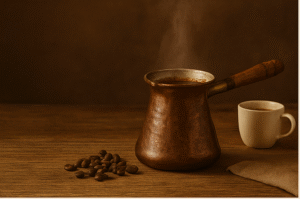
| Preparation vessel (jadhwa/karwa) | It is called "cezve" in Turkish. It should be made of brass with a long handle, and be the appropriate size for the amount of coffee. |
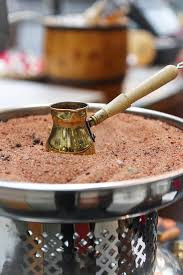
| Sand heating device | A metal box containing a thick layer of fine, clean sea sand, heated from below by a heat source (electric or gas). |
Tip: Sea sand retains heat and distributes it evenly and gently across the bottom of the pot, ensuring the coffee brews slowly without boiling over or burning.

 Preparation method step by step
This process requires some patience, but the result is worth the wait.
Step 1: Measure the ingredients
-
For each (small) cup of coffee: Use a heaped teaspoon (approximately 7 grams) of Turkish coffee.
-
Add the required amount of sugar at this stage.
-
Add one cup of cold water for every spoonful of coffee.
-
Do not stir the mixture yet!
Step 2: Initial stirring (optional)
-
Some experts prefer to place the ember directly on the sand without moving it.
-
However, you can stir the coffee, water, and sugar only once before placing the ember on the sand to ensure the sugar is mixed, then stop stirring.
Step 3: Slow cooking on sand
-
Insert the bottom of the charcoal into the hot sand. The heat should be medium to high for the process to begin.
-
The even and slow distribution of heat in the sand allows for full extraction of flavors while maintaining a creamy texture.
-
Constant monitoring is key: You will notice that the coffee starts to form at the edges first.
Step 4: Form the face (foam)
-
When the foam (face) starts to rise and gather in the middle of the pot, lift the ember slightly off the sand to temporarily lower the temperature.
-
Use a teaspoon to gather this thick foam and distribute it evenly among the cups. This foam is a sign of the quality of Turkish coffee.
-
Return the ember to the sand again to complete the cooking process.
Step 5: Final boiling and serving
-
Let the coffee rise again to the edge of the ember (avoid a full, violent boil which spoils the flavor).
-
At the second rise, quickly lift the ember off the sand.
-
Pour the coffee very slowly over the foam you previously added to the cup, starting with the cups where you added the foam first. This ensures that the sediment (ground matter) remains at the bottom of the brewing vessel and does not reach the cup.
 The secret to flavor and benefits
Why is coffee brewed on sand considered the best?
-
Even Heating: The sand ensures that the heat is even and indirect across the entire bottom of the pot, preventing the coffee from burning and allowing for optimal extraction of essential oils.
-
Velvet Texture: Slow cooking produces a richer, smoother (velvet) texture, with a dense, firm layer of foam.
-
Aesthetic Presentation: The preparation process itself is an enjoyable and attractive spectacle that adds value to the coffee-drinking experience.
Are you ready to experience the preparation of authentic Turkish coffee? Start today and enjoy the deep flavor and history that every drop carries.